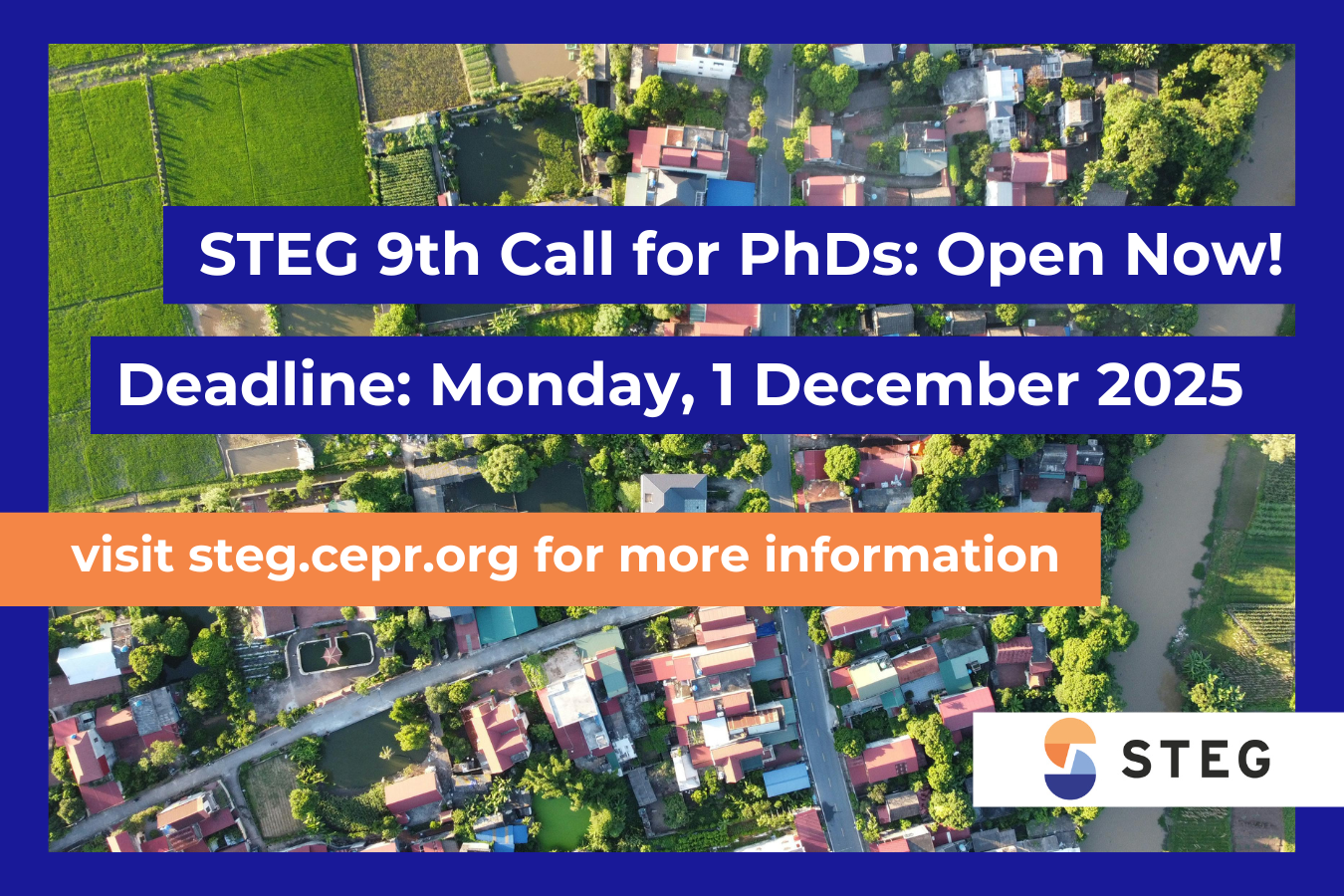

Apply now for the PhD Research Grants 2025 by STEG and CEPR. Up to £15,000 available for PhD students researching structural transformation and economic growth in low- and middle-income countries. Deadline: 1 December 2025.
PhD Research Grants 2025: Ninth Call by STEG and CEPR
If you are currently enrolled in a PhD programme and looking for financial support to advance your research, the PhD Research Grants 2025 by STEG and CEPR are now open for applications. This competitive international grant programme provides funding for research focused on structural transformation and economic growth in low- and middle-income countries, with a particular emphasis on sub-Saharan Africa.
Organized by the Structural Transformation and Economic Growth (STEG) programme and administered by the Centre for Economic Policy Research (CEPR), the call aims to empower PhD researchers from around the world to contribute new knowledge and policy insights for inclusive development.
What the PhD Research Grants Cover
The PhD Research Grants provide up to £15,000 to support research activities such as:
-
Data collection and purchase
-
Research assistance
-
Stipends (when they reduce teaching or administrative duties)
-
Field visits and travel for data gathering
Stipends are capped at £12,000 for PhD students in high-income countries and adjusted according to purchasing power parity (PPP) for those based in low- and middle-income countries.
Applicants are encouraged to ensure that proposed budgets demonstrate cost-effectiveness and value for money, following the STEG Budget Guidelines.
Research Themes and Priorities
Proposals should align with one or more of STEG’s six research themes:
-
Data, measurement, and conceptual framing
-
Firms, frictions, spillovers, and industrial policy
-
Labour, home production, and household transformation
-
Agricultural productivity and sectoral gaps
-
Trade and spatial frictions
-
The role of the public sector
Beyond these core areas, STEG also prioritizes cross-cutting issues that shape development outcomes globally:
-
Gender
-
Climate change and the environment
-
Inequality and inclusion
Projects must demonstrate policy relevance to low-income countries (LICs), particularly those in sub-Saharan Africa. Research conducted in other regions is eligible if it clearly explains how its findings apply to LIC policy contexts. Particular consideration is given to PhD students from, or based in, LIC institutions to promote global equity in research opportunities.
Eligibility Requirements
To apply for the PhD Research Grants 2025, candidates must:
-
Be currently enrolled in a PhD programme at an accredited institution;
-
Submit a letter of support from their PhD supervisor (sent within two weeks after the application deadline to steg@cepr.org);
-
Present a clear and feasible 12-month work plan;
-
Follow the official STEG PhD Research Grant Application Guidelines.
Applicants may also review the Small Research Grants (SRG) documentation for detailed examples of eligibility, country criteria, and FAQs, as the PhD grants follow similar structures with smaller budgets.
Timeline and Funding Process
-
Application Deadline:
Monday, 1 December 2025 at 23:59 GMT (UK Time) -
Funding decisions: within three months of the deadline
-
Grant duration: 12 months
-
Contract signing: within one month after final decision
Due to the high competitiveness of the programme — with an acceptance rate below 5% — applicants are advised to carefully follow the templates and guidelines available on the STEG platform.
How to Apply
Applications must be submitted online via the CEPR Hub using the official templates available on the STEG Small and PhD Research Grants page.
Apply here: Submit your PhD Research Grant Proposal via CEPR Hub
Applicants will need to upload:
-
A completed proposal form
-
Budget and timeline
-
Letter of supervisor support (sent separately)
For questions or technical issues, contact the STEG Team directly at steg@cepr.org.
Why Apply for a STEG PhD Research Grant
Winning a PhD Research Grant can be a game-changer for early-career researchers. It enables doctoral candidates to:
-
Conduct fieldwork and collect original data
-
Engage with local policymakers and institutions
-
Strengthen academic networks across the Global South
-
Gain international visibility through the CEPR and STEG networks
-
Focus on research by reducing teaching or administrative loads
These grants are not only a source of funding — they represent an opportunity to connect academic inquiry with real-world policy impact.
Key Takeaways
-
Programme: STEG & CEPR – PhD Research Grants
-
Funding: up to £15,000
-
Duration: 12 months
-
Deadline: 1 December 2025 – 23:59 GMT
-
Apply here: https://steg.cepr.org/funding/open-upcoming-funding-calls
-
Contact: steg@cepr.org
Final Note
The PhD Research Grants 2025 by STEG and CEPR are a valuable opportunity for doctoral researchers to make a meaningful contribution to development economics and policy worldwide. Whether your focus is on agricultural productivity, trade dynamics, or gender and climate inclusion, this call provides the financial and institutional backing needed to move your research forward.
Don’t miss the deadline – 1 December 2025.
Submit your proposal today through the official STEG CEPR Portal.
For more international career opportunities, visit Opportunities For Youth.